
Crochet standing stitches are a handy alternative to beginning chains, especially when joining a new yarn or starting a new round. Instead of using chains to imitate the height of your first stitch, you begin with an actual crochet stitch, giving you a cleaner and more seamless-looking start.
Standing stitches are especially useful for granny squares, motifs, and other projects where you’re joining a new color. And the best part? They’re really easy once you know the trick!
If you’re working in the round, you can pair a standing stitch with my Invisible Join and Fasten Off technique for an even cleaner finish.
What Is a Standing Stitch in Crochet?
A standing stitch is worked just like a regular crochet stitch, except you begin with a slip knot already on your hook rather than starting with a turning or beginning chain.
You can use the technique for different stitch heights, including a standing single crochet, standing half double crochet, or standing double crochet. Simply begin with a slip knot and work the stitch as you normally would.
In the example below, I’m working on my Little Boy Blue Blanket Pattern, which calls for double crochet stitches. I’ll show you how to work a standing double crochet step by step.
How to Crochet a Standing Double Crochet
Step 1: Start with a slip knot on your hook.
Step 2: Yarn over, holding onto the yarn tail so it doesn’t flip back around.
Step 3: Insert your hook into the first stitch.
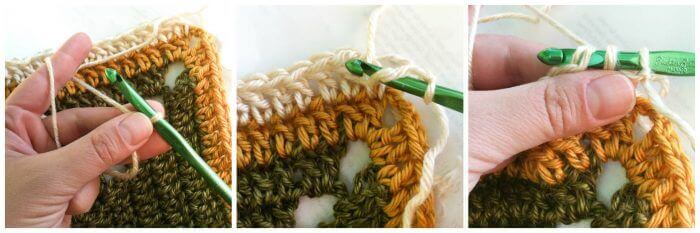
Step 4: Yarn over and pull up a loop. You should now have 3 loops on your hook.
Step 5: Complete the stitch just as you would a regular double crochet: yarn over and pull through 2 loops, then yarn over and pull through the remaining 2 loops.
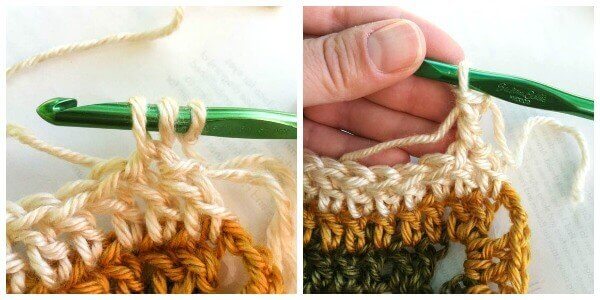
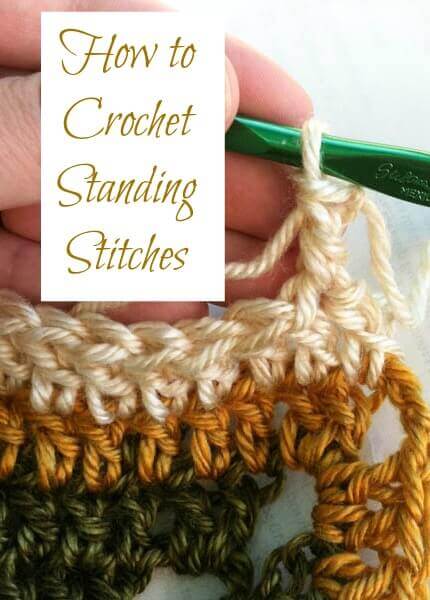
That’s it! You’ve made a standing double crochet without using beginning chains.
Using Standing Stitches for Other Crochet Stitches
You can use the same basic technique for other crochet stitches. Start with a slip knot on your hook, then work the stitch as you normally would.
For a standing single crochet, insert your hook directly into the stitch and complete a single crochet.
For a standing half double crochet, yarn over before inserting your hook, then complete a half double crochet as usual.
For a standing double crochet, yarn over before inserting your hook and complete a regular double crochet, as shown in the tutorial above.
Standing stitches are especially helpful whenever you need to join a new yarn or color because they eliminate the telltale beginning chains and help the first stitch blend in with the rest of your work.
I use this technique pretty much any time I need to join a new yarn. Once you get used to starting rounds this way, I think you’ll find it handy too!
You can find more helpful crochet tutorials and tricks on my Crochet Tutorials Page.
Tutorials You May Find Helpful
- How to Crochet Buttonholes
- How to Fix Your Yarn Ball Winder
- Free Metric Conversion Guide for Knitting and Crochet
- Four Crochet Techniques That Will Bring Your Craft to the Next Level

thanks for showing how to do this. I used this technique.
I was wondering if you could tell me how many stitches I should end up with when I am done with the Vshape part before I start the triangle part?
I am pretty new to crochet but I am up for this challenge. Thanks for your help.
I don’t understand this…there is already a row of the new color started. you crocheted a row of the new color, cut and tied off, and then started with the slip stitch thing? I keep looking at this tutorial and can’t make heads or tails out of it.
Hi Gayle 🙂 Yes, this example is from the Little Boy Blue Blanket crochet along. Per the blanket pattern we are instructed to work the rows with the right side facing for this section. So we fasten off at the end of the row and then rejoin at the beginning again. Since we are already rejoining, I thought it would look nicer to start the rows with standing stitches instead of beginning chains. If you are just working back and forth across rows with the same color, turning your work after each row, this would probably not be the method I would use since I wouldn’t want to weave in all those ends. But in the case of this pattern I would have to do that anyway. Make sense?
I don’t have a project handy to test this with… is this an easy way to start a new row, even if you aren’t changing colors? I hate the slip stitch/chain method, and I’m really excited about this idea!
Yes, except then you have to weave in ends when you otherwise wouldn’t have had to. It is really a matter of which you are willing to deal with 🙂
Soooooooooo great ,Thank you so much. 😉
Glad you found it helpful!
Super straightforward and simple! Thanks Kara 🙂 Shared.
Thanks, Rhondda!
Just recently I learned about this way of starting a new row, and I think it is brilliant!!! Thanks for sharing 🙂
I love this trick too! Thanks, Ana 🙂
OMG! This is wonderful! I can’t wait to use it on my next Granny Square! THANK YOU!!!!
My pleasure! Glad you liked it 🙂
LOVE this technique, I have been crocheting for a while, but still consider myself some what of a beginner… thank you for sharing, It cetainly is better than the 3 chain method.
Hope it comes in handy 🙂
What a great technique, Kara! 😀
Thanks, Marilyn!
thank you so much!!!!
xxxxx Ale
So glad you find it helpful 🙂
My pleasure 🙂