
To crochet a basic buttonhole, chain a few stitches, skip the same number of stitches, and continue across the row. On the next row, work into the chain space to finish the opening. Test it with your button before moving on. The button should pass through easily and stay secure once fastened.
I’ll show you how to make horizontal and vertical buttonholes, crochet a loop along the edge of your project, and sew on your buttons.
How to Space Crochet Buttonholes
Use a tape measure to space your buttons evenly, then place a stitch marker where each button will be sewn. Mark the matching positions on the opposite edge so each buttonhole or loop lines up with its button. If you’re following a garment pattern, check which edge it specifies for the buttonholes.
Horizontal Two-Row Crochet Buttonholes
A two-row buttonhole is easy to make and can be adjusted to fit different button sizes. You can work it directly into the fabric without adding a separate front band.
To line up your horizontal buttonholes with the buttons, count the rows from the lower edge of the garment to the first button marker, then count the rows between each pair of button markers. Use the same row counts on the opposite edge to mark where each buttonhole will go.
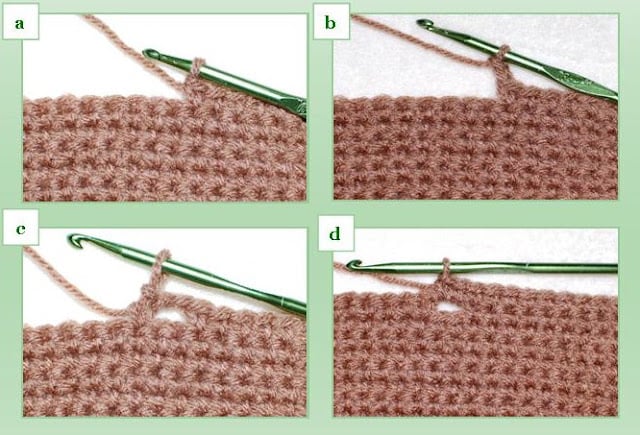
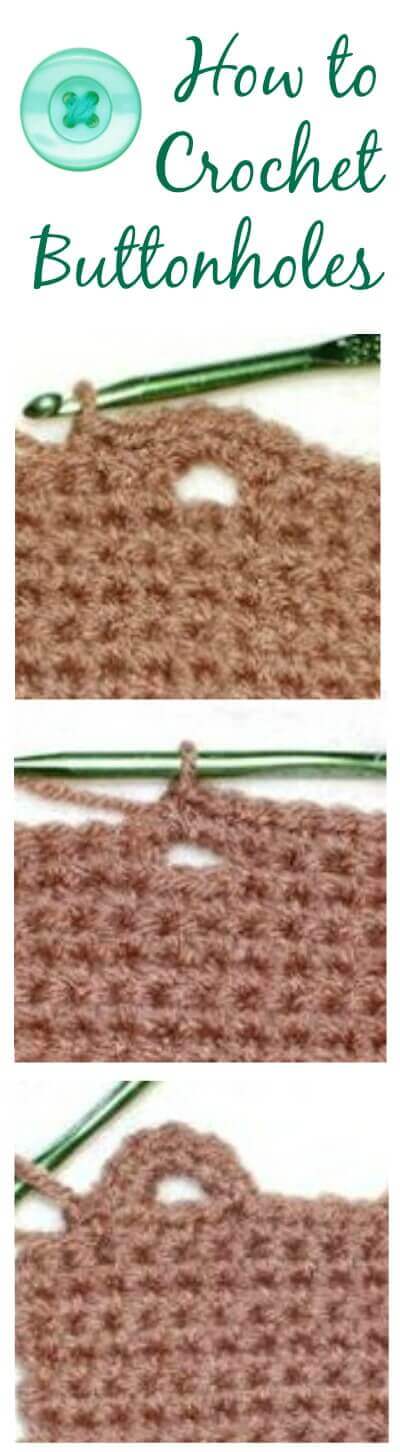
- Crochet a few stitches in from the edge, usually about ½ in. (1.3 cm) from the edge (Fig. 1a).
- Chain enough stitches to make an opening slightly smaller than the diameter of your button (Fig. 1b).
- Skip the same number of stitches as you chained, then continue crocheting across the row (Fig. 1c).
- On the next row, work into the chain space, making the same number of stitches as you chained and skipped (Fig. 1d).
Test the opening with your button. If it’s too tight or too loose, undo the buttonhole and adjust the number of chains and skipped stitches.
Vertical Two-Row Crochet Buttonholes
If your garment was worked in horizontal rows, pick up stitches along the front edge to crochet a vertical button band. Mark the center of each buttonhole so it lines up with the center of its button.
On the first row of single crochet, chain and skip stitches at each marked position as described above. On the next row, work the same number of single crochet stitches into each chain space as you chained and skipped.
Crochet Button Loops
Crochet button loops are worked along the edge of your project in the last row or last two rows. A one-row loop is usually enough for heavier yarn. For lightweight yarn or a heavier garment, a second row can reinforce the loop.
Mark the button and loop positions as described above. The row before the loops is usually worked in single crochet, though other stitches can be used.
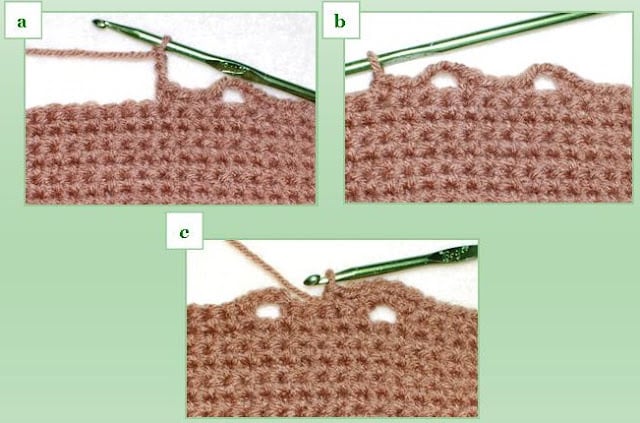
- Crochet to the placement marker, then chain enough stitches to make a loop that your button can pass through easily and that will hold it securely (Fig. 2a).
- For a small button, you can usually continue crocheting without skipping any stitches. For a larger button, you may need to skip one or two stitches before continuing across the row or to the next marker (Fig. 2b).
- To reinforce the loops, work one more row. When you reach each loop, work the same number of stitches into the loop as you chained (Fig. 2c).
Two-Step Crochet Button Loop
The two-step button loop is my favorite. It makes a sturdy closure and adds a nice finishing detail. Mark the button and loop positions as described above.
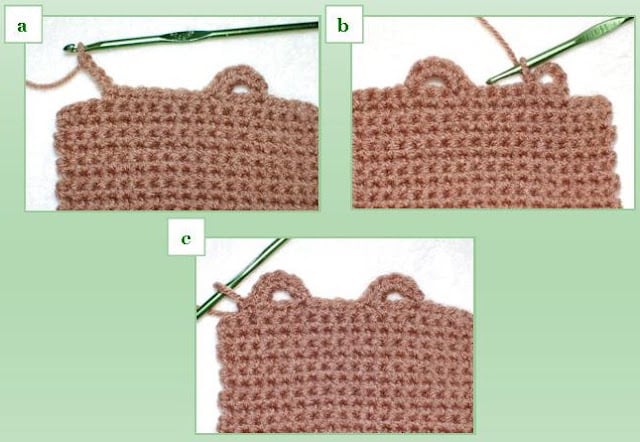
- Crochet to the placement marker, then chain enough stitches to make a loop that fits your button (Fig. 3a).
- Turn, skip two stitches, and work one slip stitch in the next stitch (Fig. 3b).
- Chain one and turn so the right side is facing you again. Work as many single crochet stitches as needed to cover the chain loop (Fig. 3c).
- Single crochet in the next stitch and continue across the row or to the next marker.
Test the loop with your button and adjust the number of chains if needed.
Sewing on Your Buttons
I like to buy one or two spare buttons in case I need a replacement later. Keep them in your sewing kit or sew a spare to the inside of your garment.
You can usually sew on your buttons with the same yarn you used for the project. If the yarn is too thick to fit through the buttonholes, separate the plies and use one or two, or use matching sewing thread.
Sew on your button. When you’re finished, knot the thread under the button, cut it leaving a tail, and weave in the tail.
Thread your needle, double the thread, and knot the ends together.
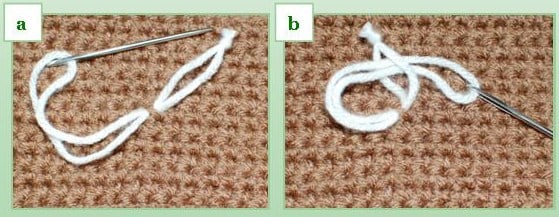
To anchor the thread and hide the knot beneath the button, insert the needle into the fabric from front to back, then bring it up to the front again (Fig. 4a).
Pass the needle between the two strands near the knot and pull the thread snug (Fig. 4b). Trim any excess thread beyond the knot.
For heavier garments, you can reinforce the closure with a backup button. Place a plain shirt button in a color that matches the yarn on the wrong side of the fabric, directly behind the decorative button. Sew through both buttons and the fabric, keeping the stitches loose enough that the fabric doesn’t pucker.
Crochet Projects With Button Closures
Want to try one of these techniques on a project? These free crochet patterns use buttons in three different ways.
- Finley the Fox Bib Crochet Pattern — Practice making small buttonholes by chaining one and skipping one stitch.
- Monster Apple Cozy Crochet Pattern — Make a chain loop that turns the monster’s eye into a working button closure.
- Broomstick Lace Cowl Crochet Pattern — Try a button closure on a wearable project with an adjustable fit.


Thank you! New crocheted here and just looking for a simple way to make buttonholes when edging woven clothing. Perfect, thank you!
great tips but i got lost on doing the button. pics didnt do me any good, need more pic to go with the words. wondering if you had plans on making a quick vid on all this!?! it would be an awesome help! thanks so much:)
I would love it if your shared this with my new blog hop: