
By Jason Ramirez, FiberTools
Blanket yardage charts are useful for getting into the right neighborhood. The problem is that yarn has a habit of changing the street signs.
Two charts can give very different answers for the same 50-by-60-inch throw, and neither one is necessarily careless. One may assume a loose double crochet fabric. Another may be based on single crochet, a different hook size, a fluffier yarn, or somebody whose tension has never once tightened during a suspenseful movie.
That is why the most useful yardage estimate does not begin with a generic chart. It begins with a swatch made from the yarn and stitch pattern you will actually use.
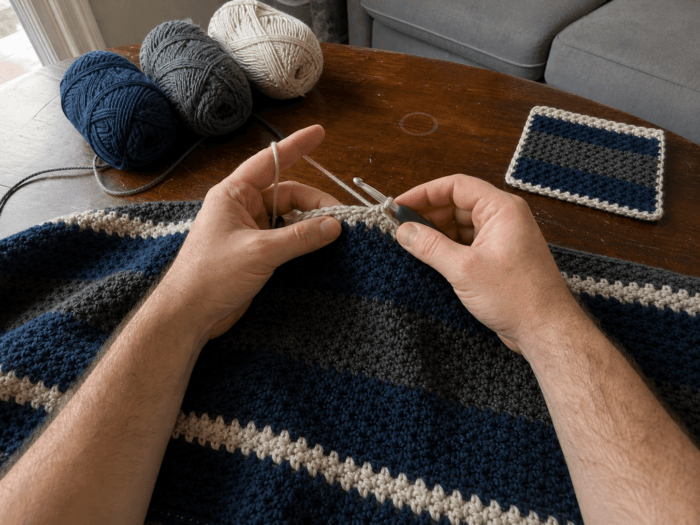
Gauge tells you size. Swatch weight tells you consumption.
Gauge answers one important question: how many stitches and rows will fit into a given space? That helps you calculate the starting chain, finished width, and number of rows.
Gauge alone does not tell you how much yarn those stitches consume.
Think about two six-inch squares. One is worked in an open mesh. The other is packed with post stitches or bobbles. They can finish at the same size while containing very different lengths of yarn. Even two fairly plain stitches can follow different paths through the fabric.
The Craft Yarn Council recommends making a gauge swatch before beginning a project and working it with the yarn, hook, or needles, and pattern stitch the project calls for. That same swatch can do a second job: when you measure its area and weigh it, it becomes a small sample of your actual yarn consumption.
The formula is simpler than it sounds.
You need five pieces of information:
- Finished blanket width
- Finished blanket length
- Swatch width and height
- Dry swatch weight in grams
- Yards and grams printed on the yarn label
First calculate the two areas:
Blanket area = finished width x finished length
Swatch area = swatch width x swatch height
Then scale the measured swatch weight to the blanket:
Estimated grams = blanket area / swatch area x swatch grams
I use a visible 10 percent planning buffer after that calculation:
Planning grams = estimated grams x 1.10
Finally, convert grams to yards using the relationship printed on the yarn label:
Estimated yards = planning grams x (label yards / label grams)
The important word is estimated. This is much more personal to the project than a broad yardage chart, but it is not a promise from the yarn universe.
A Worked Example: A Navy-and-Charcoal Throw
Suppose we are planning a 50-by-60-inch crochet throw. We make a six-inch-square swatch in the actual stitch pattern with the actual yarn and hook.
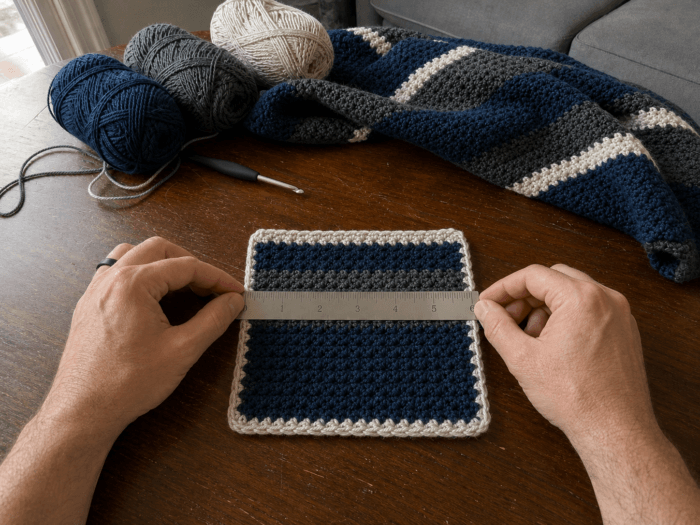
Measure the swatch flat and without stretching it. A larger swatch reduces the influence of loose or curled edge stitches.
Our project numbers are:
- Blanket: 50 x 60 inches
- Swatch: 6 x 6 inches
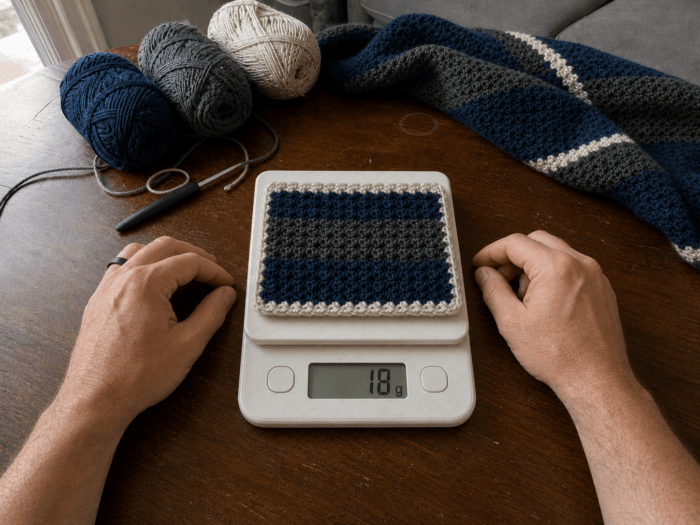
- Swatch weight: 18 grams
- Yarn label: 220 yards per 100 grams
The blanket area is 3,000 square inches. The swatch area is 36 square inches.
Divide 3,000 by 36, and the blanket is about 83.33 times the area of the swatch. Multiply that by the 18-gram swatch weight:
83.33 x 18 = about 1,500 grams
Add the 10 percent planning buffer:
1,500 x 1.10 = 1,650 grams
The yarn contains 2.2 yards per gram, because 220 divided by 100 equals 2.2:
1,650 x 2.2 = about 3,630 yards
At 220 yards and 100 grams per skein, that is 16.5 skeins. Since craft stores have not yet agreed to sell the useful half of a skein, round up to 17 skeins.
Where the Estimate Can Still Go Sideways
The calculation assumes the swatch represents the main blanket fabric. That assumption breaks when the project changes.
Borders and fringe: A wide border, tassels, or fringe consume yarn differently from the center fabric. Estimate them separately or reserve additional yarn.
Multiple stitch patterns: A sampler blanket cannot be represented accurately by one swatch if each section has a different density. Make a swatch for each major stitch pattern and estimate its section separately.
Color changes: Frequent color changes leave more tails and can create small amounts of waste. The total estimate also does not tell you how much of each color to buy unless you calculate the color proportions.
Blocking and washing: If the finished blanket will be washed or blocked, treat the swatch the same way before taking the final measurements and weight. Fiber behavior can change the dimensions.
Changing tension: A calm six-inch swatch and a full blanket worked during three months of real life may not have identical tension. Periodically compare the blanket to the swatch and measure again.
Different dye lots or discontinued yarn: The math may say 16.5 skeins, but buying all 17 at once also protects you from color differences and unavailable stock later.
How to make a swatch worth trusting
Use the exact yarn, hook or needle size, and stitch pattern planned for the blanket. Make the swatch at least four inches square; six inches gives you more interior fabric and makes the result less dependent on edge stitches.
Finish the swatch the way you plan to finish the blanket. Once it is fully dry, lay it flat without stretching, measure the width and height, and weigh it on a kitchen or postal scale that displays grams.
Do not cut the number down because it seems high. Dense crochet fabric can use a surprising amount of yarn. If the result looks unreasonable, check the inputs and make a second swatch before deciding that mathematics has developed a personal grudge.
If you would rather skip the arithmetic, I built a free Blanket Yarn Calculator that uses this same measured-swatch method. It shows the 10 percent buffer instead of hiding it and calculates yards, grams, and whole skeins from the values on your yarn label.
The Practical Bottom Line
A chart is useful when you have not chosen a yarn or stitch yet. A weighed swatch becomes more useful once the actual project decisions have been made.
The swatch method cannot remove every surprise, but it replaces a generic guess with evidence from your own yarn, stitch pattern, hook, and tension. For a blanket that may take weeks or months to finish, that is a pretty good return on one small square.
Find more handy Fiber Tools
FiberTools is a free collection of knitting, crochet, spinning, and weaving calculators. These include blanket yarn estimates, gauge conversions, crochet circles, sock and raglan math, and weaving sett calculations. I built them because project math kept showing up uninvited. They’re free, don’t require an account, and show the formulas and limitations instead of handing over a mystery number and running away. If one saves somebody from buying four extra skeins or one too few, it has done its job.
You may also enjoy:

Leave a Reply