
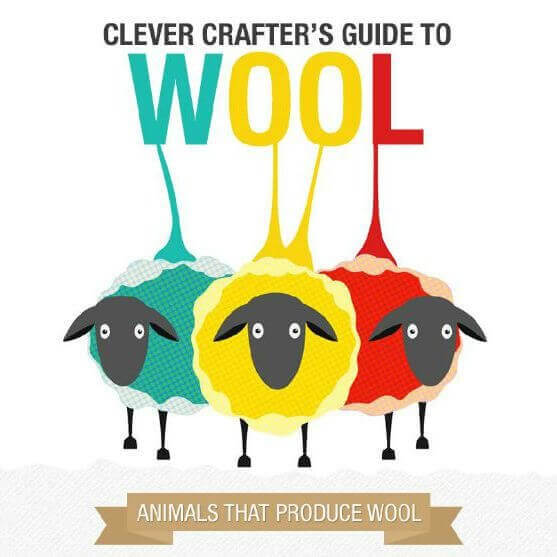
Oh, how I love a handy reference that puts useful information all in one place! This Clever Crafter’s Guide to Wool infographic is filled with interesting facts about wool, different animal fibers, yarn weights, and estimated yardage for popular knitting and crochet projects.
The folks at Clippers Ireland created this informative guide, and I thought it would be a fun resource to share with fellow yarn lovers. From sheep’s wool to specialty fibers like alpaca, cashmere, and angora, there’s plenty to discover!
Below, you’ll find a text reference covering wool types, yarn weights, and estimated yardage for different projects, followed by the complete infographic if you prefer to see everything in one visual guide.
Clever Crafter’s Guide to Wool: Text Reference
For easy reading and accessibility, I’ve included a text version of the infographic below.
Please note: The yarn quantities and sheep equivalents are illustrative estimates from the original infographic. Actual yarn requirements vary considerably depending on the project size, yarn weight, stitch pattern, gauge, and whether you’re knitting or crocheting.
Animals That Produce Wool and Other Spinnable Fibers
Many animals provide fibers that can be spun into yarn, including:
- Sheep — wool
- Goats — cashmere and mohair
- Alpacas and llamas — alpaca and llama fibers
- Camels — camel hair
- Rabbits — angora
Although these fibers are often grouped together in yarn and fiber guides, the term wool most commonly refers to fiber from sheep.
What’s the Difference Between Wool and Yarn?
Although the terms wool and yarn are sometimes used interchangeably, they’re not quite the same thing!
Wool is a natural fiber that comes from sheep. After the wool is cleaned and prepared, the fibers can be spun together to create yarn.
Yarn is the finished strand used for knitting, crochet, weaving, and other fiber crafts. It can be made from sheep’s wool, other animal fibers such as alpaca and cashmere, plant fibers like cotton and linen, or synthetic fibers such as acrylic and polyester.
So, while wool can be used to make yarn, not all yarn is made from wool!
Understanding the difference can help you choose the best fiber for your project, whether you’re looking for warmth, softness, durability, or easy care.
How Much Wool Do You Need?
For illustration, the original infographic assumes that one sheep produces approximately 500 yards (457 m) of worsted-weight wool yarn. Using that assumption, here’s how its estimated project quantities compare:
| Project | Estimated Yardage | Sheep Equivalent |
|---|---|---|
| Afghan | 3,500 yd (3,200 m) | 7 sheep |
| Hat | 225 yd (206 m) | 0.45 sheep |
| Scarf | 650 yd (594 m) | 1.3 sheep |
| Sweater | 2,100 yd (1,920 m) | 4.2 sheep |
| Vest | 1,000 yd (914 m) | 2 sheep |
These are examples from the infographic, not recommended yardage requirements for every project. The amount of usable yarn produced by a sheep also varies by breed, fleece weight, processing, and spinning.
Wool and Yarn Weight Cheat Sheet
Yarn comes in several different weight categories, which describe the thickness of the yarn rather than how much it weighs.
Common categories include:
- Lace
- Super Fine
- Fine
- Light
- Medium
- Bulky
- Super Bulky
- Jumbo
For a more complete breakdown, visit my Yarn Weights Chart, which includes recommended crochet hook and knitting needle sizes and typical gauge ranges.
Specialty Animal Fibers
The infographic also highlights several specialty fibers used in knitting, crochet, and other textile crafts:
- Camel hair: A soft, insulating fiber often used in warm garments.
- Qiviut: The exceptionally soft undercoat of the musk ox.
- Vicuña: A very fine, rare luxury fiber from the South American vicuña.
- Merino: Fine sheep’s wool known for its softness.
- Alpaca: A warm animal fiber available in different grades and textures.
- Mohair: Fiber from Angora goats, often prized for its sheen and halo.
- Llama: Fiber that can be spun into yarn for garments and accessories.
- Angora: Exceptionally soft fiber from Angora rabbits.
- Cashmere: Fine undercoat fiber from cashmere goats.
- Cashgora: Fiber from goats with characteristics associated with both cashmere and mohair.
Different fibers have their own qualities, including softness, elasticity, warmth, durability, and drape. Understanding these differences can help you choose the right yarn for your next project.
Whether you’re exploring different animal fibers, comparing yarn weights, or planning your next knitting or crochet project, I hope this guide helps you feel a little more confident choosing and working with wool. Be sure to check out the complete infographic below for a visual reference you can come back to whenever you need it!
Clever Crafter’s Guide to Wool Infographic
Want to see all this information in one handy visual reference? Take a look at the original Clever Crafter’s Guide to Wool infographic below. It’s a fun way to explore different animal fibers, yarn weights, and estimated wool quantities at a glance.
Keep in mind that the yardage figures are illustrative estimates, and actual amounts will vary by project.

More Yarn Resources & Projects to Explore
Ready to put your yarn knowledge to use? Whether you’re choosing the perfect yarn for a new project or looking for a fun way to get creative with wool, here are a few more resources and tutorials you might enjoy.
- Yarn Weights Chart – Learn about yarn weight categories, recommended hook and needle sizes, and gauge ranges.
- Introduction to Needle Felting – Discover how to turn wool fibers into adorable handmade creations using basic needle felting techniques.
- Needle Felting Projects & Tutorials – Explore felted animals, seasonal decorations, and other creative wool projects.
- Easy Yarn Crafts for All Ages – Find fun ways to create with yarn, including projects that don’t require knitting or crochet skills.

Only large people need 2100 yards of worsted-weight yarn for a sweater. And one sheep yields much more than 500 yds of worsted weight wool. It is easier to compare weights – an average sheep fleece, after cleaning and fiber prep, yields at least 4-5 lbs of usable wool. Worsted weight yarn is about 1000 ypp (yards per pound). So an average sheep fleece should yield more like 4000-5000 yards of worsted weight wool. A good rule of thumb is that you can often get 2 men’s sweaters out of one sheep fleece.
This is wonderful, Kara! Thank you so much for posting this. It is very interesting to see the comparison of with the number of sheep required per yard . . . . . very clever graphics.
So glad you found it helpful!!
Thank you so much for this. Fairly new to knitting & crochet and inherited a stash of unmarked yarn!