
Crochet gauge is the number of stitches and rows within a specified measurement. Checking it before you begin helps you see whether your chosen yarn, hook, and tension will produce the size intended in the pattern.
In this fourth learn-to-crochet lesson, I’ll show you how to check crochet gauge by making a swatch, measuring your stitches and rows, and adjusting your hook size when needed. I’ll also share a comparison of three yarns that shows why using the recommended yarn weight and hook size isn’t always enough.
Still practicing your stitches? Start with How to Crochet: Half Double, Double, and Treble Crochet, or browse the Learn to Crochet series.
What Is Gauge in Crochet?
A pattern’s gauge tells you how many stitches and rows should fit within a particular width and height when worked in the specified stitch pattern.
For example:
12 single crochet stitches × 15 rows = approximately 4 × 4 in. (10 × 10 cm)
This means that 12 stitches should measure approximately 4 in. across, and 15 rows should measure approximately 4 in. from bottom to top.
Gauge is especially important for projects that need to fit, such as hats, sweaters, and slippers. If your stitches are larger or smaller than the designer’s, your finished project may turn out a different size—even when you follow the instructions exactly.
Why the Same Yarn Weight and Hook Can Give Different Results
Using the hook size and yarn weight listed in a pattern doesn’t guarantee that your gauge will match. Every crocheter works with a slightly different tension, and yarns within the same weight category can vary in thickness, construction, and how they behave.
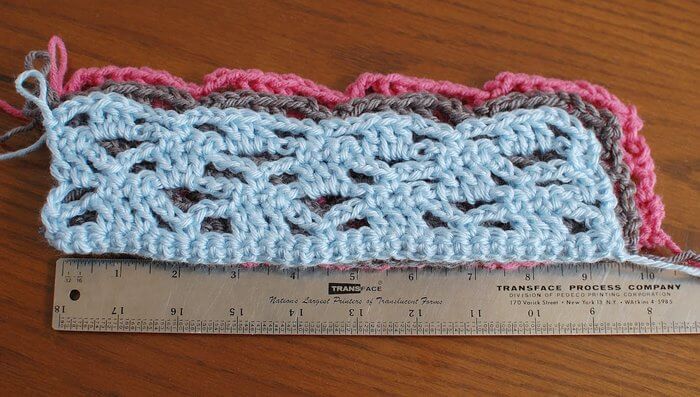
To illustrate this, I made three swatches using the same pattern and hook size, on the same night, with three worsted-weight yarns:
- Pink: Red Heart Super Saver
- Gray: Bernat Satin
- Light blue: Caron Simply Soft
There is approximately a ¾-in. (1.9 cm) difference between the Red Heart and Caron swatches. A small difference over a swatch can become a much larger difference across the width or length of a finished project.
For more help understanding yarn categories, see my Yarn Weights guide.
How to Make a Crochet Gauge Swatch
Start by reading the pattern’s gauge instructions. Check which stitch pattern to use, whether the swatch should be worked in rows or rounds, and whether the stated gauge is measured before or after blocking.
- Use your project yarn. Start with the yarn you plan to use and the hook size recommended in the pattern.
- Work the specified stitch pattern. If the gauge is given in a textured stitch or pattern repeat, use that rather than substituting single crochet.
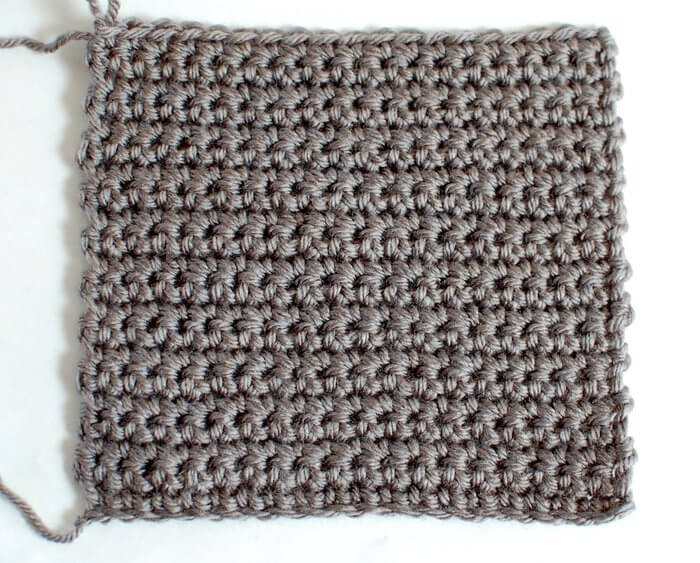
- Make the swatch larger than the measuring area. To measure a central 4-in. (10-cm) area, aim for a swatch approximately 6 in. (15 cm) square, or larger if needed for the stitch repeat. Follow the pattern’s specific swatch directions when provided.
- Work with your normal tension. Crochet comfortably rather than deliberately tightening or loosening your stitches to reach the stated gauge.
If you need help comparing hook sizes, refer to my Crochet Hook Size Chart.
Should You Wash or Block Your Gauge Swatch?
Follow the pattern’s instructions for preparing the swatch. For a project that will be washed, it’s helpful to measure before and after washing and drying according to the yarn label and the care method you’ll use for the finished item.
Let the swatch dry completely before measuring again. Avoid stretching it to force it to match the gauge.
Some yarns grow, relax, or change texture after washing. Finding that out with a small swatch is much easier than discovering it after finishing a garment.
See my blocking guide for more help.
How to Measure Crochet Gauge
Lay the prepared swatch flat on a firm surface without stretching it. Use a ruler or gauge tool to measure in the center, away from the starting chain, turning chains, and outer edges.
Count the Stitches Across
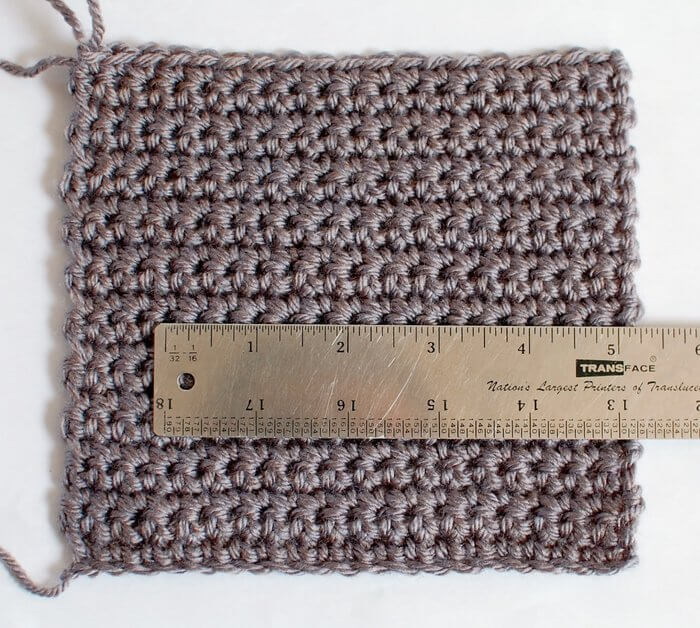
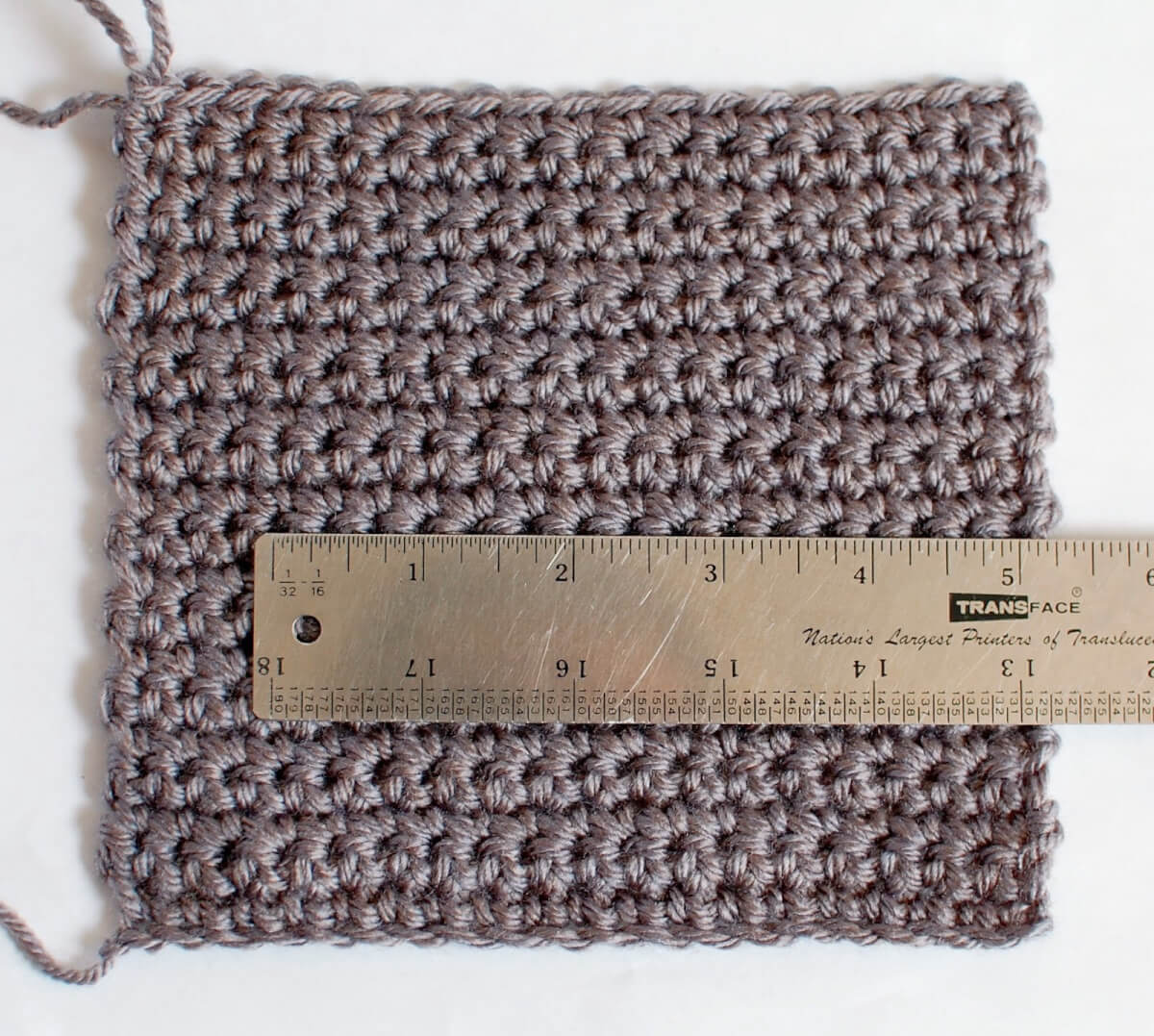
Place your ruler horizontally across the swatch. Count the stitches within the measurement specified in the pattern, including any partial stitches at the end of that measurement.
In this example, I counted 12 single crochet stitches across 4 in. (10 cm).
Count the Rows Vertically
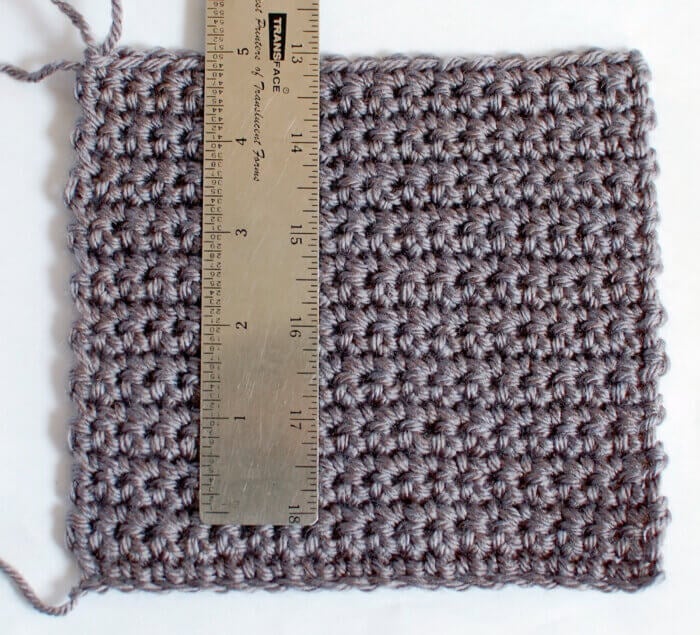
Turn your ruler vertically and count the rows within the specified measurement, again including partial rows where needed.
In this example, I counted 15 rows over 4 in. (10 cm).
Check more than one area of the swatch if possible. If the counts vary noticeably, make a larger swatch and practice maintaining a comfortable, consistent tension.
How to Adjust Your Crochet Gauge
Compare your stitch and row counts with the pattern’s gauge over the same measurement.
| Your stitch count | What it means | First adjustment to try |
|---|---|---|
| More stitches than specified | Your stitches are narrower, so the project may turn out too narrow | Try a larger hook |
| Fewer stitches than specified | Your stitches are wider, so the project may turn out too wide | Try a smaller hook |
| The stitch count matches | Your stitch width matches the pattern | Check your row gauge next |
After changing hook size, make another swatch and prepare it in the same way before measuring.
Also check how the fabric feels. If matching gauge produces fabric that is much too stiff or too loose for the project, reconsider whether your yarn is a suitable substitute. Matching the yarn-weight category alone doesn’t guarantee the same results.
What If Stitch Gauge Matches but Row Gauge Doesn’t?
Stitch gauge measures width; row gauge measures height.
- More rows within the stated height means your rows are shorter
- Fewer rows within the stated height means your rows are taller
If your stitch gauge matches but your row gauge doesn’t, first confirm that you used the correct stitch pattern and prepared the swatch as directed.
For a simple project worked to a measured length, you may be able to adjust the number of rows. For fitted garments, shaping, or patterns with fixed row counts, changing rows can affect how the pieces fit together. Check the pattern’s guidance before making adjustments.
Changing hook size affects both stitch width and row height, so recheck both measurements after each change.
When Does Crochet Gauge Matter?
Gauge matters most when the finished dimensions affect fit or function, including hats, clothing, slippers, and pieces that must fit together.
For a scarf or simple blanket, an exact match may be less important if you’re comfortable with a different finished size. However, gauge still affects dimensions, fabric drape, and how much yarn you’ll need.
Taking a little time to swatch can help you choose the right hook, understand your yarn, and begin your project with more confidence.
Continue Learning to Crochet
Need to revisit the basics? Return to Learn to Crochet: Hook and Yarn Basics or practice with How to Crochet: Half Double, Double, and Treble Crochet.
Explore more crochet tutorials and keep my crochet resources and reference charts handy as you learn.

Thank You!! This was EXTREMELY helpful!! I’m just learning to crochet and didn’t quite understand how to adjust things to get a swatch to match the pattern I was trying. I am very surprised with how many people don’t understand this. This makes perfect sense and cannot be said enough.
Thanks so much, Holly! So glad you found it helpful 🙂
thanks for this great tip!!would love it if you could share this on my link party –
thank you very much for the tips! My crocheted hats and socks always turn to be too small…Because I am always too lasy to try first!
I must admit I’ve done it too 😉
Great series!!
This is great. I’m in the process of organizing a learning to sew series. 🙂
WOW you have some gorgeous projects! I learned to to crochet once and made pot holders and slippers. Everyone told me it would be a stress reliever. I felt more stressed trying to figure it out! haha However I appreciate the work and love it when my mom makes beautiful crochet blankets and scarfs for me.http://fitcraftystylishandhappy.blogspot.com/
I think gauge is probably the most important thing in crochet or knitting – and yet I don’t know of anyone who likes to do it. It seems like it’s wasting time, but a few minutes at the beginning of a project is a lot better than making a sweater that is way too big or way too small!
Thanks for stopping in at Cranberry Morning. Glad you liked my garden jeans. 🙂
This is perfect for me! I always have a hard time with figuring out gauge. I want to make a sweater but….., a gauge is a must. You make it look pretty simple.:) I thing I’ll try it again.
I featuring this at our party tomorrow morning. Thanks for parting with us girlie.:)
I enjoyed this post on gauge. I’m doing a dishcloth challenge right now so gauge is not as important for me yet, but I hope to make some hats, slippers, etc. soon. I’ve been following you on Facebook and I read your newsletter yesterday. Very nice! I’m a newbie myself but having a fun time creating my website/blog. Thanks for the tips and patterns!