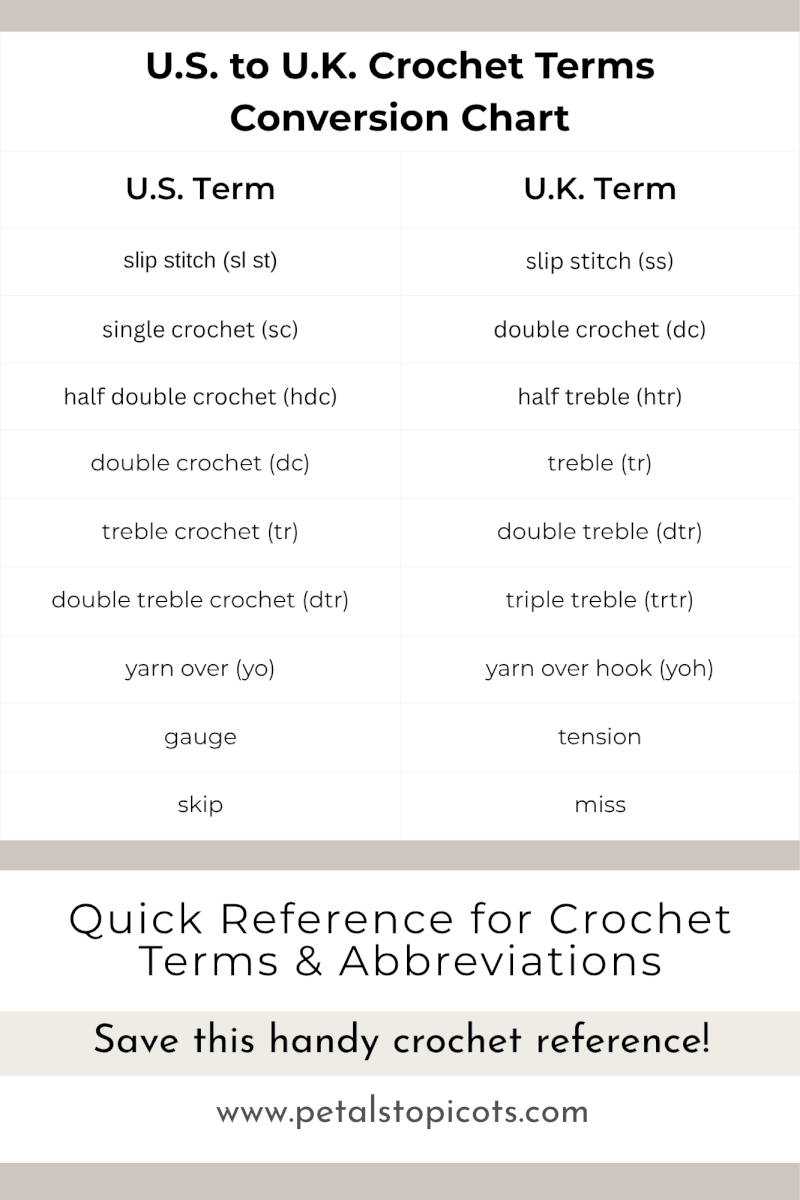
U.S. and U.K. crochet patterns use many of the same stitch names, but those names don’t always mean the same stitch! For example, a U.S. single crochet is called a double crochet in U.K. terms, while a U.S. double crochet is called a treble crochet in U.K. terms.
Use this U.S. to U.K. crochet conversion chart to quickly translate common crochet stitches and abbreviations when working from a pattern written in different terminology. You can use the chart in either direction to convert U.S. crochet terms to U.K. terms or U.K. crochet terms to U.S. terms.
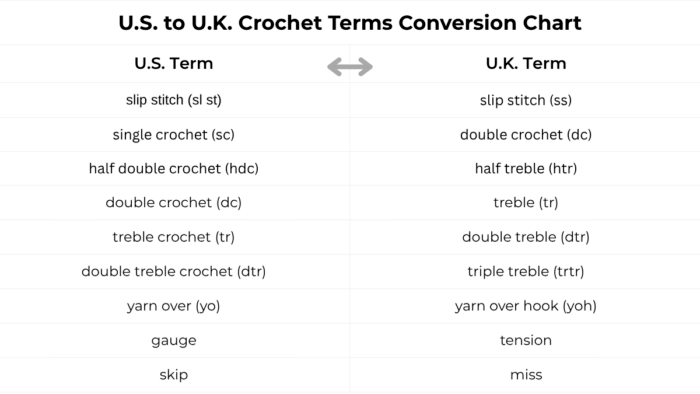
U.S. to U.K. Crochet Terms Conversion Chart
| U.S. Term | U.K. Term |
|---|---|
| slip stitch (sl st) | slip stitch (ss) |
| single crochet (sc) | double crochet (dc) |
| half double crochet (hdc) | half treble (htr) |
| double crochet (dc) | treble (tr) |
| treble crochet (tr) | double treble (dtr) |
| double treble crochet (dtr) | triple treble (trtr) |
| yarn over (yo) | yarn over hook (yoh) |
| gauge | tension |
| skip | miss |
A Quick Example
Double crochet is a good example of why it’s important to know which terminology a pattern uses. The abbreviation dc appears in both U.S. and U.K. patterns, but it refers to different stitches.
A U.S. double crochet (dc) is a U.K. treble crochet (tr).
A U.K. double crochet (dc) is a U.S. single crochet (sc).
The stitch itself doesn’t change—you’re simply translating the name used for that stitch.
How to Tell if a Crochet Pattern Uses U.S. or U.K. Terms
Most crochet patterns will tell you whether they are written using U.S. or U.K. terminology, usually in the pattern notes or abbreviation section. If the pattern doesn’t specify, there are a few clues that can help.
If you see single crochet (sc), you’re most likely looking at U.S. terminology. U.K. terminology doesn’t use single crochet; the equivalent stitch is called double crochet.
If you see half treble (htr), that’s a good indication the pattern is using U.K. terminology. The equivalent U.S. stitch is half double crochet (hdc).
You may also see gauge in a U.S. pattern where a U.K. pattern may use tension, or skip a stitch in U.S. instructions where U.K. instructions may say miss a stitch.
Converting a Crochet Pattern
Once you know which terminology a pattern uses, use the chart above to translate each stitch into the terminology you’re familiar with. Be sure to convert the stitch everywhere it appears, including decreases and other combined instructions.
For example, a U.K. dc2tog corresponds to a U.S. sc2tog because U.K. double crochet is the same stitch as U.S. single crochet.
You don’t need to change stitch counts simply because you’re converting the terminology. You’re working the same stitches called for in the original pattern, just translating their names.
What About Australian Crochet Terms?
Australian crochet patterns have traditionally followed U.K. crochet terminology, but that isn’t universal. Some Australian designers and publications may use U.S. terms, so check the pattern notes or abbreviation key rather than assuming which terminology is being used.
What About Tunisian Crochet?
Tunisian crochet has its own set of stitch names and abbreviations, so the standard U.S.-to-U.K. stitch conversions in the chart above generally don’t apply. If you’re working on a Tunisian crochet project, visit my Tunisian Crochet Tutorials for more help with the technique.
More Crochet Resources
- Crochet Abbreviations
- U.S. to Metric Crochet Hook Size Chart
- Metric Conversion Guide for Knitting and Crochet
- Crochet Stitch Chart Symbols
- Yarn Weights Chart
- Laundry Care Symbols
- Clever Crafter’s Guide to Wool