
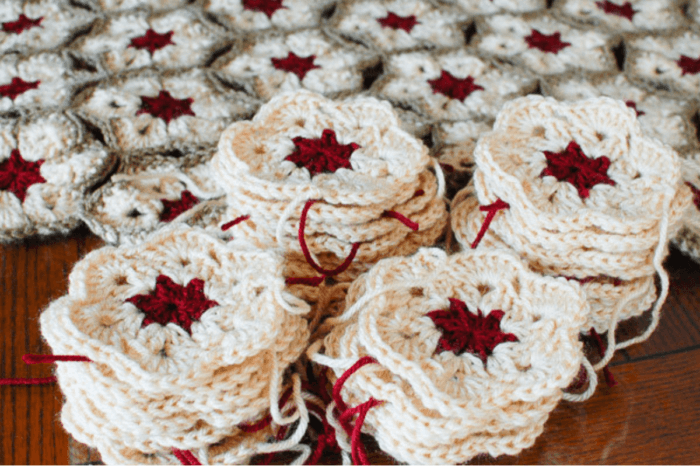
The African Flower crochet motif is a beautiful six-petal design that can be used to create blankets, coverlets, pillows, bags, and other colorful crochet projects. This free African Flower crochet pattern shows you how to make the motif in just three rounds, with instructions for continuing to create the traditional six-sided African Flower hexagon.
I’ve gotten so many compliments and pattern requests for this design over the years. Some people even told me the motifs look like Jammie Dodgers—and I have to admit, I can see the resemblance!
For this particular project, I stopped after Round 3 rather than completing the traditional hexagon. I had recently made a hexagon blanket and wanted to try something a little different. If you enjoy working with crochet hexagons, you may also like my Crochet Hexagon Pattern and Photo Tutorial. Since I was making these motifs into a bed coverlet rather than a traditional afghan, I also liked the lighter coverage of the three-round version.
Want to make your own African Flower motifs? Let’s get started!
African Flower Crochet Pattern Instructions
What You’ll Need
- 3 colors of worsted-weight yarn, such as Lion Brand Yarn Vanna’s Choice
- H / 5.0 mm crochet hook
- tapestry needle, scissors
This pattern is written in U.S. crochet terms. Refer to the U.S. to U.K. Crochet Conversion Chart to convert. You can also refer to my Crochet Abbreviations resource.
❤️ this African Flower pattern on Ravelry.
Abbreviations
- CA – color A
- CB – color B
- ch – chain
- dc – double crochet
- beg – beginning
- sps – spaces
- st – stitch
- Lsc – long single crochet (see below for instructions)
Special Stitch: Long Single Crochet
Long single crochet (Lsc): Insert hook in designated space and pull up a loop to the height of the row being worked; complete as a single crochet.
Rounds 1–3: Three-Round African Flower Motif
Choose your version:
- 3-round African Flower motif: Stop after Round 3 for the flower-shaped motif used in my coverlet.
- Traditional African Flower hexagon: Continue through Rounds 4 and 5 to create the classic six-sided motif.
With CA, make a magic ring (as an alternative to the magic ring, you can also chain 4 and join in the furthest ch from hook to form a ring).
Round 1: Ch 3 (counts as 1st dc), work 1 dc in ring, ch 1, *2 dc in ring, ch 1, rep from * 4 more times, join in top of beg ch 3, fasten off — 12 dc and 6 ch-1 sps.
Round 2: Join CB in any ch-1 sp, ch 3 (counts as 1st dc), work [1 dc, ch 5, 2 dc] in same ch-sp as color was joined, *ch 1, [2 dc, ch 5, 2 dc] in next ch-1 sp, rep from * 4 more times, ch 1, join with a slip stitch in top of beg ch 3 — 24 dc and 6 ch-5 sps.
Round 3: Sl st in next dc and in next ch-5 sp, ch 3 (counts as 1st dc), work 6 dc in same ch-sp, *ch 1, work 7 dc in next ch-5 sp, rep from * 4 more times, ch 1, join with a slip stitch in top of beg ch 3, fasten off — 42 dc and 6 ch-1 sps.
If you’re making the three-round flower as a standalone motif, you can stop here or continue with the border round below. If you’re planning to join your motifs, skip to the How to Join African Flower Motifs section. To turn the flower into the traditional African Flower hexagon, continue to the Traditional African Flower Hexagon Pattern section.
Border Round for the Three-Round Motif: Join CC in the first dc of any 7 dc-grouping from the previous row, ch 1 (does not count as st), work 1 sc in same st as color was joined and in next 6 sts, *work 1 Lsc over the ch-1 sp from Round 3 and into the ch-1 sp from Round 2, work 1 sc in each of the next 7 sts, rep from * 4 more times, work 1 Lsc into the ch-1 sp from Round 2, join with a slip stitch in first st of round, fasten off — 48 sts.
How to Join African Flower Motifs
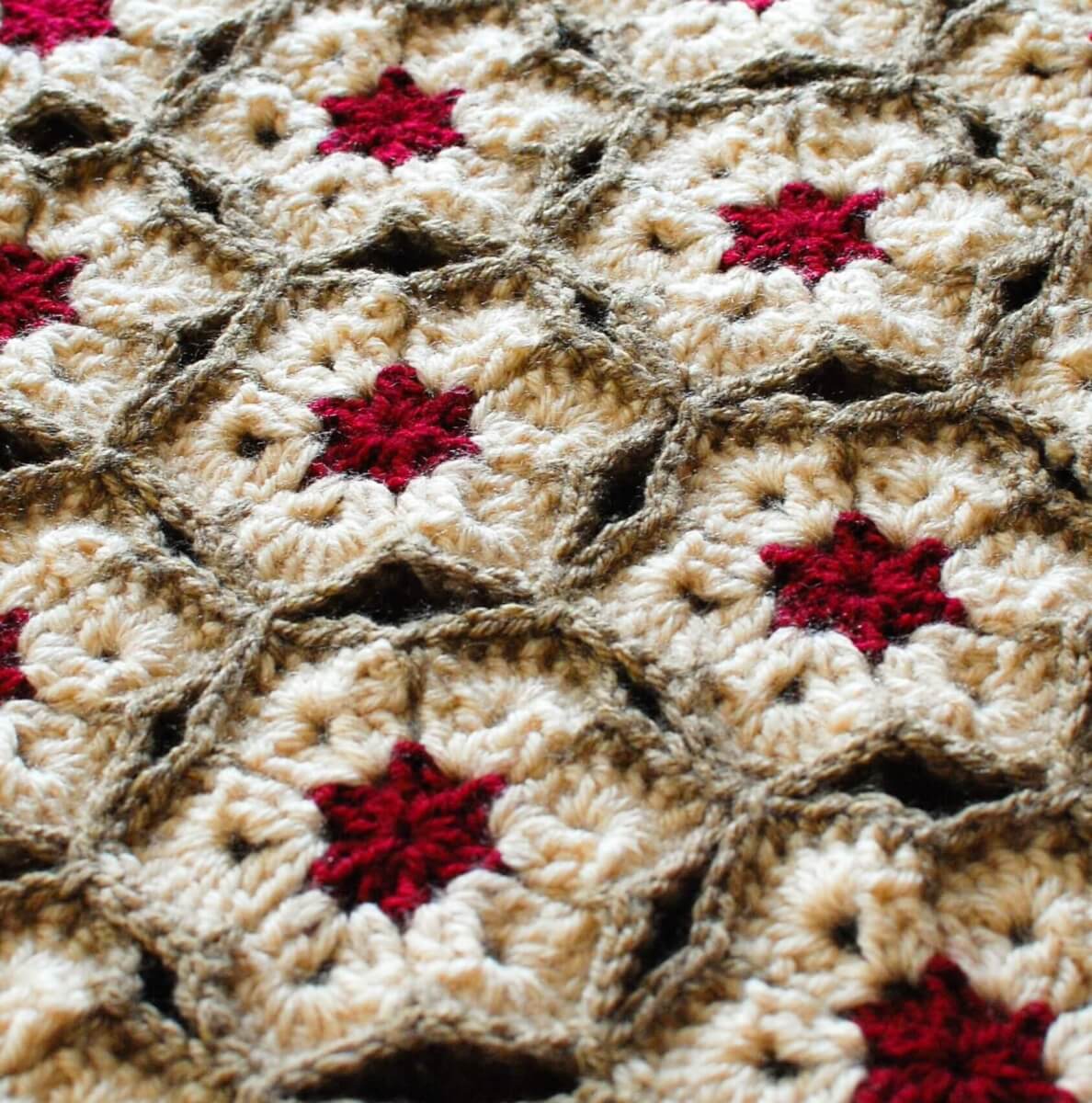
Once you’ve made your motifs, you can use the Join As You Go Method (JAYGO) to connect them without sewing them together afterward. For my coverlet, I used the JAYGO as follows:
For the first motif only, join CC in the first dc of any 7 dc-grouping from the previous row, ch 1 (does not count as st), work 1 sc in same st as color was joined and in next 6 sts, *work 1 Lsc over the ch-1 sp from Round 3 and into the ch-1 sp from Round 2, work 1 sc in each of the next 7 sts, rep from * 4 more times, work 1 Lsc into the ch-1 sp from Round 2, join with a slip stitch in first st of round, fasten off — 48 sts.
For subsequent motifs, follow the same pattern, but when you reach the side to join, after working your Lsc, work 1 sc in each of the next 3 sts, ch 1, then drop the loop from your hook and insert it into the 4th sc of the motif you want to join it to, put the loop back on your hook and pull it through, now continuing to work back in your current motif, work 1 sc in each of the next 4 sts. Repeat this for the next petal of your motif.
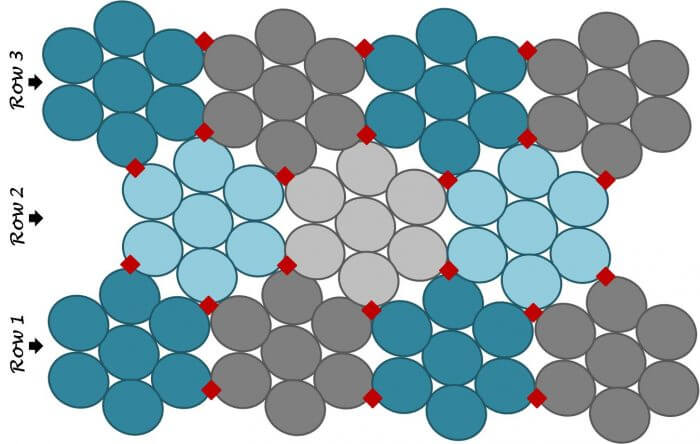
Each motif should join to another at 2 points. See the diagram below for placement of the motifs. Joining points are indicated by the red diamonds.
African Flower Crochet Diagram for Joining
Traditional African Flower Hexagon Pattern
To make the traditional hexagon African Flower motif, follow Rounds 1 through 3 above and then continue on as follows:
Round 4: Join CC in the first dc of any 7 dc-grouping from the previous row, ch 1 (does not count as st), work 1 sc in same st as color was joined and in next 6 sts, *work 1 Lsc over the ch-1 sp from Round 3 and into the ch-1 sp from Round 2, work 1 sc in each of the next 7 sts, rep from * 4 more times, work 1 Lsc into the ch-1 sp from Round 2, join with a slip stitch in first st of round, fasten off — 48 sts.
Round 5: Join CD in same st, ch 3 (counts as 1st dc), work 1 dc in each of the next 2 sts, *[1 dc, ch 1, 1 dc] in next st, 1 dc in each of the next 7 sts, rep from * 4 more times, [1 dc, ch 1, 1 dc] in next st, 1 dc in each of the next 4 sts, join with a slip stitch in top of beg ch-3, fasten off — 54 sts.
Ideas for African Flower crochet motifs
- Blankets and afghans
- Bedspreads and coverlets
- Pillows
- Bags and purses
- Scarves
- Baby blankets
- Home decor
See African Flower Crochet Projects
Want to see what other crocheters have made? Check out the African Flower projects on Ravelry for color inspiration and ideas for putting your motifs together.
Frequently Asked Questions
How many rounds are in the African Flower crochet pattern?
This flower-shaped version includes three rounds for the flower-shaped motif. You can continue with two additional rounds to create the traditional six-sided African Flower hexagon.
What can I make with African Flower crochet motifs?
African Flower motifs can be joined to make blankets, coverlets, pillows, bags, scarves, and other crochet projects.
How do you join African Flower crochet motifs?
These motifs can be joined using a join-as-you-go method, which allows you to connect them while working the final round rather than sewing them together afterward.
Find Community
I would love to see your finished African Flower projects; share them with me on Instagram, Facebook, or the Petals to Picots Community.
More Crochet Motif & Hexagon Patterns

thank you for sharing
Hope you enjoy it!
Thanks for sharing! I been looking for a new project for my living room.
So glad you like it!
Meant joining my motifs now. Did you embroider the joining red areas together?
Love this pattern. I’m not joining my motifs and did them as I went. Did you do each row than join the rows, or join as you crotched the edges? I’ve completed the first row and now have noticed that each motif in a row is joined only on the two bottom areas where I’ve joined the last two petals at two areas, thus making it joined to the next motif 4 times. Guess I’ve goofed somewhere. Any enlightening on this will be helpful.
Thanks
Hi Karen 🙂 I joined my while working the last edging round of each flower. Each petals should join to an adjacent petal except for in the outer rows of your blanket. Make sense? The red triangles on my joining diagram indicate the points at which each flower joins another. Hope that helps!
Yes, it’s makes sense. Thanks so very much. I love this pattern and will just need to put the rows together since I’ve done all the motifs together.
I have been wanting to make this flower and putting it off. I now am going to make it.
Thank you soo much I have been crocheting MOST of my life Learned from books. My MOM started me with the basic stitches.
I will be 82 years young next month. I am still learning. So much to do.
Happy early birthday 🙂 I love learning new things too!
Thanks for the birthday wishes I have so much i want to do and so little time.
Still trying to figure how many 50g balls I need for a throw please?
Vicki
Hi Vicki 🙂 This is still a work in progress for me too so I’m not sure what my final yardage will be.
Hi Kara,
How many skeins of each color will I need to make this project?
Thanks,
Judy
I Love this pattern! I too was wondering if you have finished it yet, and know how many
skeins it took. I think a lot of afgans use about 50-60 oz. I was hoping this was close to that!
Hi Kris 🙂 Nope, I am embarrassed to say but my afghan is still a work in progress. Sorry 🙁
LOL! Don’t feel bad, i still have those kinda projects that have been sitting around the house for a year “unfininished”. I tend to see new patterns that i “suddenly” need to make! LOL!
Hi, I started this project when all free crochet posted it on Facebook, I got a little sidetracked until today when I decided to pick it back up again. This is such a fun pattern, and so easy to! My only question is how many motifs would it take to make a throw. I’m not sure how big a throw should be but something that you snuggle up with while watching tv. Any ideas?
Thanks!
Hi Sam 🙂 I am so glad you are enjoying the pattern! Good question … it really depends on how big you would like it to be. I usually just keep making them until I reach the size I like (or am sick of the project, hehe 😉 ). A typical throw is usually about 50 in. by 60 in.
Ahhh, a Jewish star! Few patterns are available. Thank you!
Thank you for sharing this lovely pattern.
Hi Kara,
Love this pattern! Thank you for posting it. I would like to know how many motifs did you make. I’m not sure if you made 11 motifs or 77 motifs per your diagram. Much appreciated. I will be making this for my mother, I think she’s going to love it!
Thanks,
Judy
Hi Judy 🙂 The diagram represents 11 motifs.
Ok great! Thanks again!!! 🙂