
I can’t wait to dig into needle felting with you! If you follow along with me on Instagram, you know how much I love needle felting. There is just something so relaxing about it … taking a handful of fluffy wool, poking it until it molds into the shape you want. It’s such a peaceful and restorative process for me; I put a little background music on and completely get lost in my project.
So, if you’re new to needle felting, I’d love to give you a little introduction and show you just how easy it is to get started …
What Is Needle Felting?
Needle felting is the process of using a special barbed needle to repeatedly agitate animal fibers until they interlock and bind together, creating a dense and durable fabric or form. Wool is most commonly used for needle felting, but other protein animal fibers, such as alpaca, camel, yak, cashmere, mohair, angora, and llama, can also be felted. Although all of these fibers have properties that allow them to felt, some are more suitable for the purpose than others.
Needle felting is different from the process used to felt a finished knitting or crochet project. In my guide to Felting Knitting & Crochet, I explain how hot water, soap, and agitation are used to shrink and felt knitted or crocheted fabric.
Needle felting works on the same basic principle of agitating the fibers, but uses a felting needle instead of water and heat. As the needle works in and out of the wool, its tiny barbs catch the scales on the fibers and cause them to interlock and bind together.
Basic Needle Felting Supplies
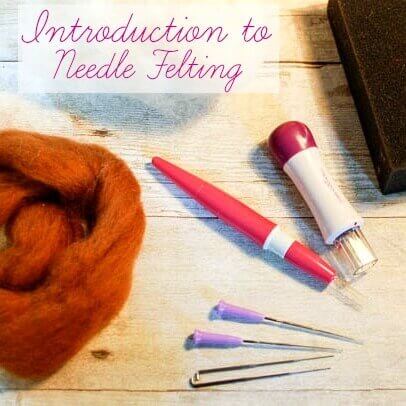
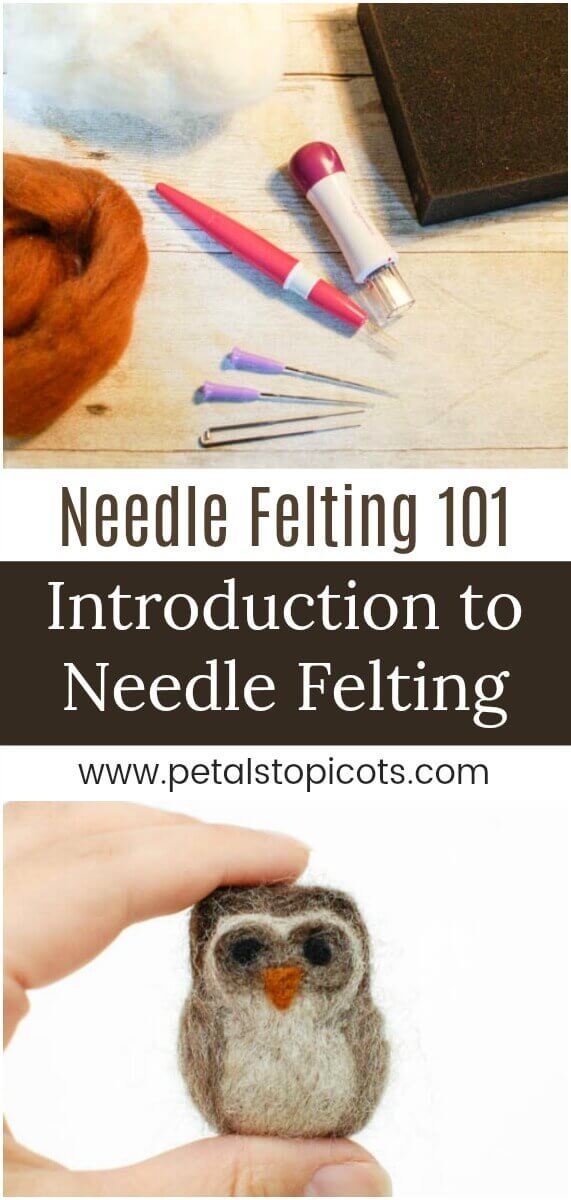
Here are some basic tools and supplies you need to get started …
- Felting needles — These are very sharp barbed needles (ouch!) that are available in a variety of sizes, from very fine (about 42 gauge) to coarse (32 gauge). A 36- or 38-gauge needle is a good all-around one to have. You can use a single needle or a holder that houses a few.
- Foam pad — The pad will support your project and protect your work surface and your needles.
- Wool roving — Any fiber that felts can be needle felted (some more easily than others), but wool fiber is the standard.
- Wool batting — Wool batting is carded wool arranged in a thick sheet or batt. It’s often useful for building up the core of larger needle-felted projects.
- Scissors
That’s all you really need to get started. Depending on the type of project you are working on, you may also use some cotton piping cord, craft eyes, sewing needle and thread, pipe cleaners, beads, glue, etc.
How to Needle Felt
That’s the easy part! Just start poking away at your wool with your felting needle. Make sure to use your foam pad as a support and to protect your surface. Keep your needle straight as you poke up and down to keep it from breaking. This is called needling. You don’t need to poke too deep; keep moving your piece around so the wool won’t stick to the foam pad. You will notice your wool becoming denser and more compact.
Start with a loose amount of wool slightly larger than the finished shape you want, since the fibers will become smaller and denser as you work. Continue turning and shaping the wool as you needle felt so it firms up evenly on all sides. You can add small amounts of wool as you go to build up areas or refine the shape.
Keep poking until you get the shape you want. That’s all there really is to it!!
Ready to give it a try?
Try out some of these needle felting projects.

There are lots of needle filters on You Tube and Etsy. if you don’t know about the art or the name, you will better understand the craft. You’ve Likely seen needle felted pieces and just don’t realize it.
In the article you wrote that needle felting is the process of taking fibers, condensing and binding them to create a very durable fabric. I’d imagine that if you are working with such coarse and often thick fibers, you’d want a durable machine to help. I’ll have to look up good machines that are often used in needle felting.
There is no machine needed. It is just a hand held felting needle. All manually done. No machine required.
I’ve never seen needle felting done so I am an absolute beginner, absolute beginner!
I understood the list of supplies, sort of, well, I’m not worried about them as I’m sure I can find them by your description.
When it got to the part where you actually do the felting it didn’t make sense. I’m probably just dense or tired (just got back from shopping for clothes with my 16 yo daughter) because no one else seemed to have a problem.
I just start poking where with what? Just the needle? Do I just poke a piece of wool with a needle? Do I have wool yarn or piece of wool cloth? What do I use the other supplies for?
Sorry I am so dense. I’ll go find some videos and maybe it will make sense.
You have a great blog!
Great tut! Needle felting is a lot of fun and it has great creative possibilities!
Thanks, Cotilde!
Great tutorial!
I’ve always wanted to try needle felting, Kara! I wan’t wait to join in your series!
There’s a gentleman who needlefelts at a scrapbook store where I teach. He makes some amazing things!
Thanks for the great tutorial.
Blessings 🙂
Sounds like fun!